
Why Your Dog Is Inflamed: Oxidative Stress, Missing Minerals, and the Holistic Path Back to Health
- SUP Stewards Under Pressure

- May 24
- 12 min read
Updated: Jun 5
Logos, Information, and the Order of Things
By Stewards Under Pressure: Terrain Wellness | Quantum Biology | YHWH Covenant
Rooted Saviors | Biofield App
An introduction to oxidative stress in canine health — what causes it, what symptoms it creates, and how grounding, nutrition, herbs, red light therapy, and minerals can restore your dog's natural vitality.
If your dog is scratching constantly, struggling with stiff joints, dealing with recurring ear infections, carrying dull or patchy fur, or just seeming less vibrant than they used to — the root cause is rarely a single isolated problem. More often, these symptoms are signals pointing to the same underlying imbalance: oxidative stress.
Oxidative stress sounds like a technical term, but the concept is straightforward. Every cell in your dog's body produces small amounts of reactive oxygen species (ROS) — unstable molecules that are a natural byproduct of energy production and immune activity. In a healthy, well-nourished dog living a natural life, antioxidant systems neutralize these molecules as fast as they're produced. The system stays in balance.
The problem is that modern dogs often don't live natural lives. They eat ultra-processed food stripped of living nutrition. They spend most of their time indoors on synthetic flooring, never touching bare earth. They lack the mineral density their bodies need to run their antioxidant enzyme systems. And they accumulate chronic low-grade stress from confinement, isolation, and environmental exposures their physiology was never designed for.
The result is a body that can no longer neutralize oxidative load as fast as it builds. And the symptoms — the itching, the joint pain, the gut trouble, the allergies, the fatigue — follow.
This post is an introduction to that process: what oxidative stress is, why it's so common in modern dogs, what the most common symptoms look like, and what a whole-animal, terrain-focused approach to restoring balance actually involves.
"The symptoms your dog is showing are not random. They are signals from a system under oxidative load — and the path back to health runs through the terrain, not just the symptom."
What Oxidative Stress Actually Is
Every cell in the body — canine or human — runs on energy produced by the mitochondria. That process inevitably generates reactive oxygen species: molecules with unpaired electrons that are highly reactive and potentially damaging. Normally, the body neutralizes these with antioxidant enzymes — superoxide dismutase, catalase, glutathione peroxidase — which depend on specific minerals to function.
Oxidative stress occurs when that balance tips: when ROS production exceeds the body's capacity to neutralize it. Free radicals begin damaging cell membranes, mitochondria, proteins, and DNA. The immune system responds with inflammation. And inflammation, in turn, generates more ROS — creating a self-reinforcing spiral.
In dogs, the most common drivers of this imbalance are:
• Ultra-processed commercial diets — high in refined carbohydrates and synthetic additives, low in the bioavailable minerals that antioxidant enzyme systems require
• Mineral deficiencies — particularly magnesium, zinc, selenium, and copper, all of which are cofactors for key antioxidant enzymes
• Chronic low-grade stress — cortisol suppresses immune function, depletes antioxidant reserves, and directly promotes oxidative load
• Indoor confinement — no access to bare earth means no grounding, no sunlight exposure, and none of the free electron supply the Earth naturally provides
• Environmental toxic burden — flea and tick chemicals, lawn pesticides, synthetic cleaning products, plastic food bowls, and poor water quality all add oxidative load
• Overuse of antibiotics and other medications — which can disrupt gut microbiome integrity and deplete glutathione
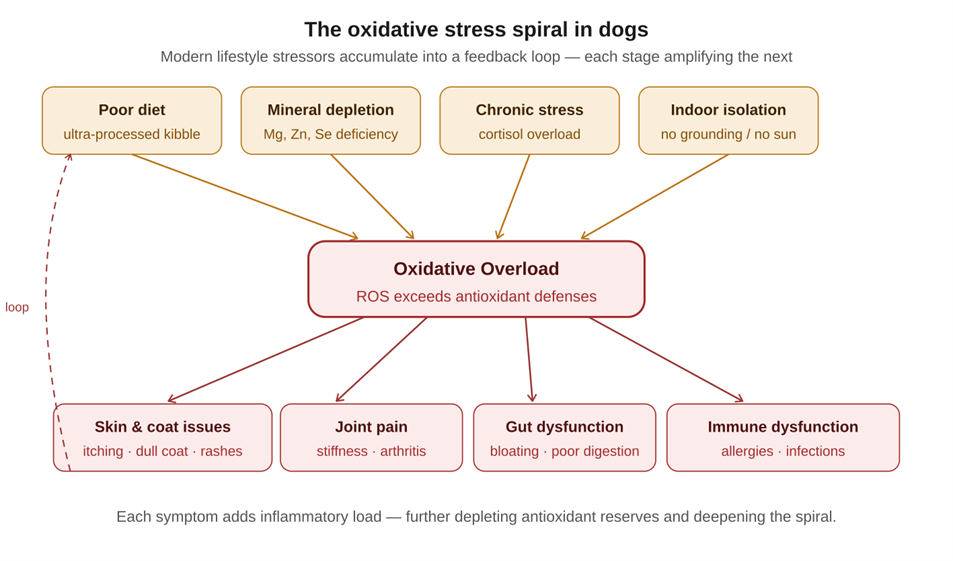
Figure 1: The oxidative stress spiral in dogs — modern lifestyle stressors accumulate into a feedback loop that drives the most common chronic health issues.
The Most Common Signs of Oxidative Stress in Dogs
Because oxidative stress affects every major organ system, its symptoms are wide-ranging. Many of the conditions that veterinarians diagnose as separate problems — allergies, arthritis, gut dysfunction, anxiety, skin disease — share this common upstream root.
Skin and Coat Problems
The skin is often the first place oxidative stress becomes visible. Itching, redness, hot spots, recurring infections, dull or brittle coat, and excessive shedding are all signs of compromised skin barrier function and elevated inflammatory signaling. The skin's antioxidant defenses — which include vitamin E, vitamin C, and glutathione — are among the first to be depleted when systemic oxidative load is high.
Many dogs diagnosed with 'allergies' are actually experiencing a generalized inflammatory state driven by oxidative imbalance. The trigger (pollen, food protein, dust mite) may be real, but the severity of the reaction reflects how little reserve the immune system has — which is determined largely by antioxidant and mineral status.
Joint Pain and Stiffness
Inflammation is the primary driver of canine osteoarthritis and joint degeneration. Oxidative stress damages joint cartilage directly — reactive oxygen species degrade the proteoglycans that give cartilage its cushioning properties, and they activate inflammatory enzymes (matrix metalloproteinases) that accelerate joint breakdown. Dogs showing early morning stiffness, reluctance to use stairs, or reduced enthusiasm for exercise are often showing signs of chronic low-grade joint inflammation rooted in systemic oxidative load.
Digestive Issues
The gut lining is a rapidly dividing tissue with high metabolic demands — and high vulnerability to oxidative damage. A compromised gut barrier allows bacterial products and undigested proteins to enter the bloodstream, driving systemic inflammation and immune dysregulation. Recurring gas, bloating, irregular stools, and food sensitivities all point toward gut barrier stress that frequently has oxidative origins. The gut microbiome itself is sensitive to oxidative stress and is disrupted by the same mineral deficiencies and processed diets that drive systemic ROS accumulation.
Immune System Dysfunction
Both underactive immunity (frequent infections, slow wound healing, persistent parasites) and overactive immunity (allergies, autoimmune conditions) can reflect oxidative imbalance. Immune cells — neutrophils, macrophages, T cells — are exquisitely sensitive to their redox environment. They require balanced antioxidant support to function precisely, and they malfunction in both directions when that balance is disrupted.
Low Energy, Anxiety, and Cognitive Decline
Mitochondrial function — the cellular process that produces energy — is directly impaired by oxidative stress. Dogs that seem older than their age, tire easily, sleep excessively, or show anxiety and restlessness may be experiencing the systemic energy deficit that accompanies chronic oxidative overload. In older dogs, oxidative damage to brain tissue is a primary driver of canine cognitive dysfunction — the canine equivalent of dementia.
The Holistic Restoration Approach
Restoring a dog from chronic oxidative stress is not about treating each symptom separately. It's about addressing the terrain — the underlying conditions that determine whether the body can maintain redox balance on its own. The following five approaches work together, each targeting a different layer of the problem.

Figure 2: Five pillars of canine oxidative stress restoration — each addresses a different layer of the oxidative burden.
1. Nutrition — Rebuilding from the Foundation
Food is the most fundamental intervention. Ultra-processed kibble — even 'premium' brands — is typically cooked at extremely high temperatures that destroy enzymes and oxidize fats, stripped of the bioavailable mineral complexity that living food carries, and supplemented with synthetic versions of nutrients that are often poorly absorbed. It is also frequently high in refined carbohydrates that spike blood sugar, generate glycation end-products, and fuel inflammatory pathways.
Transitioning toward whole, minimally processed food — raw or gently cooked proteins, organ meats, bone broth, leafy greens, berries, and appropriate vegetables — gives the body the living nutrition it was designed to use. Organ meats in particular (liver, kidney, heart) are extraordinarily dense in bioavailable B vitamins, iron, zinc, and copper. Blueberries, broccoli sprouts, and dark leafy greens provide potent plant-based antioxidants including anthocyanins, sulforaphane, and vitamins C and E.
Even partial transitions — replacing a portion of kibble with whole food — can meaningfully reduce the oxidative burden from diet while the dog adjusts.
2. Key Herbs — Botanical Antioxidant Support
Many herbs provide concentrated antioxidant and anti-inflammatory compounds that are highly bioavailable and well-tolerated by dogs in appropriate doses. The following are among the most well-researched and applicable:
• Turmeric — curcumin modulates NF-κB inflammatory signaling and is one of the most studied natural anti-inflammatories. Use with a small amount of healthy fat and black pepper (piperine) to enhance absorption. Start with very small amounts and increase gradually.
• Milk thistle (silymarin) — strongly hepatoprotective, supports liver detoxification, and regenerates glutathione — the body's master antioxidant. Particularly valuable for dogs with toxic burden or on long-term medications.
• Spirulina and chlorella — high in chlorophyll, proteins, and antioxidant phycocyanin. Spirulina has research support for reducing inflammation and oxidative markers, supporting immune function, and improving gut health in animals.
• Nettle leaf — mineral-dense and anti-inflammatory, particularly useful for dogs with skin and respiratory allergy symptoms. Provides bioavailable iron, calcium, magnesium, and quercetin.
• Ashwagandha — an adaptogen that helps regulate the HPA axis and cortisol production. Reduces stress-driven oxidative load; useful for anxious or stressed dogs. Use in very small, species-appropriate doses.
• Ginger — anti-inflammatory and digestive, supports gut motility and reduces nausea. Well-tolerated in small amounts.
Always introduce herbs one at a time in small amounts, and consult a holistic or integrative veterinarian before beginning any herbal protocol, especially for dogs on medications or with serious health conditions.
3. Targeted Mineral Support
Minerals are the structural foundation of antioxidant enzyme systems. Without adequate mineral status, even a perfect diet cannot fully compensate. The most critical minerals for canine antioxidant function include:
• Zinc — essential cofactor for superoxide dismutase (SOD), one of the body's primary antioxidant enzymes. Zinc deficiency is extremely common in dogs on processed diets and is directly linked to skin problems, immune dysfunction, and poor wound healing.
• Selenium — essential for glutathione peroxidase, the enzyme that neutralizes lipid peroxides. Deficiency is associated with muscle degeneration, immune failure, and increased cancer risk. Selenium from whole food sources (organ meats, fish) is safer than synthetic supplementation.
• Magnesium — regulates hundreds of enzymatic reactions, stabilizes cell membrane voltage, and is depleted rapidly under stress. Low magnesium is associated with anxiety, muscle cramping, and cardiovascular irregularities.
• Copper — cofactor for SOD and required for iron metabolism and connective tissue integrity. Should be supplied in balance with zinc.
• Omega-3 fatty acids (EPA and DHA from fish sources) — resolve inflammation through specialized lipid mediators (resolvins and protectins), protect cell membranes from lipid peroxidation, and support brain and joint health.
These are best supplied through whole food sources where possible — raw organ meats, small oily fish, and whole food supplements — rather than isolated synthetic minerals, which are often poorly absorbed and can create imbalances.
4. Red Light Therapy — Restoring Mitochondrial Function
Red and near-infrared (NIR) light therapy — using wavelengths between approximately 630 and 850 nanometers — directly supports mitochondrial function by interacting with cytochrome c oxidase, the terminal enzyme in the electron transport chain. This interaction improves ATP production efficiency, reduces mitochondrial ROS generation, and triggers cellular repair and anti-inflammatory signaling pathways.
In dogs, red light therapy has been applied with encouraging results for:
• Joint pain and arthritis — multiple studies show reduced inflammation and improved mobility in osteoarthritis
• Wound healing and skin conditions — accelerates tissue repair and reduces inflammatory skin conditions
• Coat quality and follicle health — improves circulation to skin and supports hair follicle activity
• Post-surgical recovery and injury healing
• Anxiety and nervous system regulation — via vagal and autonomic pathways
Red light sessions for dogs are typically 5–15 minutes, positioned so the light can penetrate the target tissue without staring directly into the device. Most dogs tolerate it well and often relax or become sleepy during sessions. Start with shorter sessions and observe your dog's response.
Grounding — The Missing Daily Practice
Of all the interventions described in this post, grounding may be both the simplest and the most consistently undervalued.
The Earth's surface carries a mild negative electrical charge and is continuously replenished with free electrons by lightning activity and the atmospheric electrical circuit. When a living body makes direct contact with natural ground — through bare paws on grass, soil, sand, or clay — those electrons flow up into the body through conductive pathways. This is not a metaphor or a wellness trend. It is basic physics, and its biological effects are increasingly well-documented.
Free electrons from the Earth have a direct antioxidant effect: they neutralize reactive oxygen species by donating the unpaired electron that makes ROS unstable and destructive. In this sense, grounding is the most direct electron donation therapy available — and it's free, requires no equipment, and was part of every dog's daily life for the entirety of canine evolutionary history.
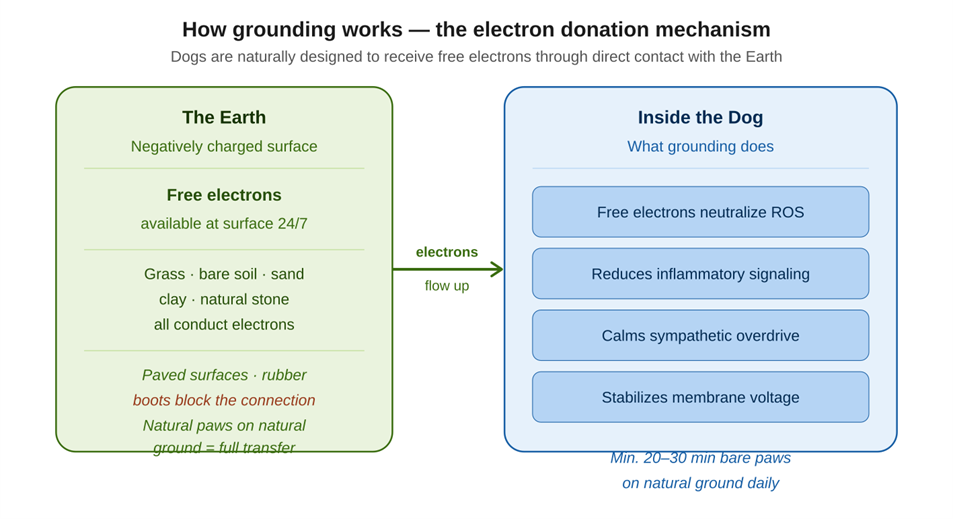
Figure 3: How grounding works — the electron donation pathway from Earth through bare paws into the body's antioxidant systems.
Research on grounding in humans has shown measurable effects on inflammatory markers, cortisol rhythms, sleep quality, blood viscosity, and autonomic nervous system regulation. While specific canine grounding studies are limited, the underlying physiology is identical: dogs evolved as animals whose paws were continuously in contact with natural ground. The conductive pads of canine paws are extremely well-suited to this kind of electron exchange.
What disrupts this in modern dogs:
• Living predominantly indoors on synthetic flooring (carpet, laminate, tile) which is electrically insulating
• Walking only on paved surfaces — concrete and asphalt also block the connection
• Wearing boots or protective coverings on paws (when used routinely rather than for specific protection)
• Spending insufficient time in natural environments
The practice is straightforward: allow your dog daily time with bare paws on natural ground — grass, garden soil, sand at the beach, natural stone. At minimum 20–30 minutes of contact, ideally with free movement and some sunlight exposure. This single change, done consistently, can reduce chronic inflammatory load, improve sleep quality, and contribute meaningfully to the antioxidant environment you're building through nutrition and supplementation.
Sunlight exposure during grounding time adds another layer: ultraviolet and infrared wavelengths support circadian hormone regulation, vitamin D synthesis (through the skin and eyes), and mitochondrial energy production. A dog moving freely on natural ground in morning or late afternoon sunlight is receiving a constellation of inputs that modern indoor life almost entirely eliminates.
"Dogs are designed to be on the Earth. Every day they spend on natural ground is a day their antioxidant system gets the electron supply it was built to receive."
Putting It Together — A Practical Starting Point
You don't need to do everything at once. The following is a sensible sequence for introducing terrain-based support for a dog showing signs of oxidative stress:
• Week 1–2: Begin grounding sessions — at least 20–30 minutes of bare paws on natural ground daily. This is immediate, costs nothing, and starts the electron supply chain.
• Week 2–4: Assess and begin improving diet. Even adding organ meats (liver, kidney) two to three times per week to existing food significantly increases mineral density and antioxidant precursor availability.
• Week 3–6: Introduce one herb at a time in small amounts. Start with turmeric (with fat and black pepper) or spirulina, which are well-tolerated by most dogs. Observe for any reaction before adding the next.
• Ongoing: Consider targeted mineral support — particularly omega-3 from fish oil, and a quality whole-food mineral supplement if full diet transition isn't immediately possible.
• When available: Begin red light therapy sessions (5–10 minutes, 3–5 times per week) targeting areas of concern — joints, skin, abdomen for gut support.
Track changes over 4–8 weeks: coat quality, itching frequency, energy levels, stool consistency, joint mobility, and overall demeanor are all reliable indicators of improving terrain.
The Bigger Picture
The symptoms we see in dogs — the itching, the stiff joints, the gut trouble, the anxious behavior — are not arbitrary. They are the body's honest report on the conditions it's operating in. And those conditions, in most modern dogs, include chronic oxidative overload driven by depleted nutrition, indoor isolation, minimal grounding, and accumulated toxic burden.
The good news is that the same systems that tip into dysfunction under those conditions are also highly responsive to restoration. The antioxidant systems rebuild. Inflammation resolves. Mitochondria regain efficiency. Skin barriers repair. Joint tissue heals. Dogs — like all animals — are built with a strong drive toward health when the terrain supports it.
Every time your dog walks on natural ground, eats real food, receives good herbal and mineral support, or lies in morning sunlight, they are receiving inputs aligned with millions of years of biological design. That alignment is not a treatment. It is a return to the conditions under which health is the natural default.
To explore how these principles connect to equine wellness and the full terrain-based approach at Rooted Saviors, visit rootedsaviors.com.
Note: This post is for informational purposes. Always consult a qualified veterinarian — ideally one with integrative or holistic training — before making significant changes to your dog's diet, supplements, or health protocol, particularly if your dog has existing health conditions or is on medications.
Sources & Further Reading
The following peer-reviewed sources informed this post:
1. Ozkaya M. et al. (2016). Oxidative stress in dogs with chronic inflammatory conditions — Veterinary Medicine International — review of oxidative stress markers across common canine chronic diseases.
2. Chevalier G. et al. (2012). Earthing: Health implications of reconnecting the human body to the Earth's surface electrons — Journal of Environmental and Public Health — grounding research showing effects on inflammation, cortisol, and autonomic regulation.
3. Oschman J.L. et al. (2015). The effects of grounding (earthing) on inflammation, the immune response, wound healing, and prevention and treatment of chronic inflammatory and autoimmune diseases — Journal of Inflammation Research — comprehensive review of grounding mechanisms and biological evidence.
4. Hamblin M.R. (2017). Mechanisms and applications of the anti-inflammatory effects of photobiomodulation — AIMS Biophysics — red and NIR light therapy mechanisms, mitochondrial effects, and anti-inflammatory pathways.
5. Looney A.L. et al. (2018). A randomized blinded placebo-controlled trial investigating the effects of photobiomodulation therapy on canine elbow osteoarthritis — Veterinary Surgery — clinical trial of red light therapy in canine joint disease.
6. Bhavana Y. et al. (2021). Spirulina platensis as an antioxidant supplement in canine health — Journal of Animal Physiology and Animal Nutrition — spirulina antioxidant effects in dogs.
7. Nelson R.W. & Couto C.G. (2019). Small Animal Internal Medicine (6th ed.) — Elsevier — standard reference covering inflammatory, immune, and metabolic disease in dogs with mineral and nutritional dimensions.
8. Fascetti A.J. & Delaney S.J. (2012). Applied Veterinary Clinical Nutrition — Wiley-Blackwell — comprehensive canine clinical nutrition reference including mineral requirements and antioxidant systems.
9. Henrotin Y. et al. (2019). Is there any scientific evidence for the use of phytotherapy in canine osteoarthritis? — Veterinary Sciences — review of herbal anti-inflammatory compounds including curcumin in canine joint disease.
10. Sundaram R.K. et al. (1996). Antioxidant status and lipid peroxidation in type II diabetes mellitus with and without complications — Analogous mineral-antioxidant enzyme relationships applicable to canine oxidative stress physiology. European Journal of Clinical Nutrition.
11. Knecht M. et al. (2023). Glutathione and selenium in canine health — Review of glutathione peroxidase function, selenium dependence, and antioxidant enzyme systems in dogs. Antioxidants.
12. Bauer J.E. (2011). Therapeutic use of fish oils in companion animals — Journal of the American Veterinary Medical Association — omega-3 fatty acids, anti-inflammatory mechanisms, and clinical applications in dogs.
rootedsaviors.org | biofieldapp.com | stewardsunderpressure.org | Terrain Wellness | Quantum Biology | YHWH Covenant


Comments