
The Quantum Body: Why Frequency, Light, and Minerals Are Not Optional
- SUP Stewards Under Pressure

- May 24
- 18 min read
Updated: Jun 5
Logos, Information, and the Order of Things
By Stewards Under Pressure: Terrain Wellness | Quantum Biology | YHWH Covenant
Rooted Saviors | Biofield App
An introduction to the peer-reviewed science of mitochondrial quantum biology, what it tells us about how living bodies actually work, and why the terrain-based practices we recommend at Rooted Saviors — minerals, sunlight, frequency, red light, rest — are not lifestyle preferences. They are operating instructions for the machine we are all made of.
For most of the last century, the cell has been taught as a chemical machine. Substrates go in, products come out, and what happens between is the patient work of enzymes — classical, predictable, dependable. It is a useful picture. It is also incomplete.
Over the past two decades, physicists have walked into biology and found something the textbooks did not prepare us for. The mitochondrion — the small organelle inside every one of our cells, and every cell of every animal we care for — is not a chemical machine alone. It is a quantum machine. Electrons inside it tunnel through energy barriers that classical physics says should stop them. The mitochondrion itself emits faint light. That light travels through the cell's internal architecture like signal through fiber optic cable. And faint magnetic fields, weaker than the Earth's own, reach into this machinery and modulate it directly.
This is not speculation, and it is not on the fringe. It is published research, in the same journals where the rest of medicine and biology is published — Nature Communications, Science Advances, Communications Biology, Biochemical Society Transactions, Entropy, the International Journal of Molecular Sciences. And it changes how we think about why specific frequencies, specific wavelengths of light, specific minerals, and specific rhythms of stillness and stress actually do what we have long observed them to do.
This post is an honest, grounded introduction to what that science says, what it means for the terrain-based approach we apply at Rooted Saviors, and why the practices we recommend — daily sunlight, mineral support, red light therapy, frequency-based wellness, and rhythmic stress and recovery — are not optional. They are operating instructions for the quantum architecture you and your animals are made of.
The mitochondrion is not a chemical machine. It is a quantum machine. And the practices we have always called wisdom — sunlight, minerals, rest, rhythm — turn out to be the operating instructions for that machine.
The Mitochondrion Is a Quantum Machine
Inside every cell of every living thing, electrons travel distances they have no business traveling. Through the four protein complexes of the mitochondrial electron transport chain — the assembly line that produces ATP, the energy currency of the body — electrons cross gaps of fifteen to thirty ångström. That is a barrier classical physics says should stop them. They cross anyway. This is quantum tunneling, and without it, there would be no ATP, no muscle, no thought, no heartbeat.
In 2019, the neurologist James P. Bennett published a paper in Medical Hypotheses that reframed the entire question of neurodegeneration. Parkinson's, Alzheimer's, ALS — these diseases, he argued, do not begin as failures of biochemistry. They begin as oxidative damage to the electron tunneling proteins themselves: the iron-sulfur clusters, the heme groups, and the FAD cofactors that hold the quantum architecture in place. Damage the substrate, and the tunneling stops. Stop the tunneling, and the neuron starves.
In a 2021 follow-up paper with Isaac Onyango, Bennett extended the argument. The adult human brain consumes twenty to twenty-five percent of the body's glucose and oxygen on only two to three percent of its weight. That extraordinary demand is paid by the quantum tunneling of electrons and protons through a protein scaffold so finely tuned that even small damage cascades outward. Mitochondria, the authors wrote, may be the organelle at which the quantum world transitions into the classical — and the place where the cost of that transition is paid first.

Figure 1: Three documented quantum mechanisms operating inside every mitochondrion — electron tunneling through the energy production chain, biophoton emission carrying signal through microtubule waveguides, and frequency response that allows faint magnetic pulses to rebuild damaged organelles.
Why this matters for what we feed
The architecture that does this tunneling is made of specific atoms. Iron-sulfur clusters require iron and sulfur. Heme groups require iron. FAD cofactors require riboflavin (vitamin B2). The protein scaffolds that hold these together require copper, manganese, molybdenum, and magnesium to function. When we talk about mineral status — for horses, for dogs, for ourselves — we are not talking about an abstract nutritional checklist. We are talking about the literal atomic substrate of the quantum machine that keeps the body running.
Most modern diets are deficient in exactly these trace minerals. Industrially grown feed crops are grown in soils that have been depleted for decades. Processing strips what is left. The default condition of a modern body — animal or human — is mild to moderate deficiency in the minerals that the electron transport chain absolutely cannot function without. This is not a controversial claim. It is a consequence of how the food system actually works.
This is why the remineralisation work we describe across all Rooted Saviors content is not optional supplementation. It is the rebuilding of an atomic substrate that has been quietly eroded by a century of industrial agriculture — and that the quantum biology of the cell cannot work without.
Faint Frequencies Can Reach Into the Cell
In May of 2022, a team led by Takuro Toda at Nagoya University published a paper in Communications Biology — an open-access journal in the Nature family. They had built a small magnetic coil that produced pulsed fields at one to eight hertz, with a peak intensity of ten microtesla. To put that in perspective: ten microtesla is three times weaker than the magnetic field of the Earth itself.
They placed cells in the coil and waited. Within three hours, mitochondrial mass had dropped to seventy percent of baseline. The cells were not dying — they were being renewed. The faint pulses had selectively inhibited Complex II, the second link of the electron transport chain. That inhibition triggered the cellular cleanup pathway called mitophagy — the body's own process for identifying damaged mitochondria and recycling them. Twelve hours later, the cells had built back stronger. Mitochondrial membrane potential — the basic measure of how well the organelle is doing its job — was forty percent higher than where it had started.
The mechanism, the authors suggested, runs through the FAD and iron-sulfur clusters of Complex II — the same structural motifs that birds use, through the cryptochrome protein, to sense the Earth's magnetic field for navigation. The quantum substrate that lets a robin cross an ocean is, in mammals, the substrate that lets a faint frequency rebuild the mitochondrion from within.
Why this matters for frequency-based wellness
The frequency band that Toda used — one to eight hertz — overlaps almost exactly with two things that are not coincidence. The first is the Schumann resonance, the natural electromagnetic background of the Earth's atmosphere, whose fundamental frequency is approximately 7.83 Hz. The second is the theta band of mammalian brainwave activity: the rhythm of deep meditation, REM sleep, and the unhurried attention of skilled work.
This is the experimental floor on which frequency-based wellness rests. When practitioners — for themselves, for their horses, for their dogs — work with PEMF (pulsed electromagnetic field) therapy in the low-hertz band, with grounding mats that re-establish contact with the Earth's natural field, or with audio frequencies in the theta range, they are not engaging in metaphor. They are working with the same parameter space that, in a peer-reviewed Nature-family journal, was shown to rebuild mitochondria.
A separate paper published in 2024 in the International Journal of Molecular Sciences carried a title that would have been unthinkable a decade ago: Sound Matrix Shaping of Living Matter — Mitochondria as Energy Portals in Detecting and Processing Sound Vibrations. The authors showed that specific styles of music modulated mitochondrial function in cultured human cells through identifiable molecular pathways. Every cell, they wrote, vibrates at defined frequencies, generating its own sound signature.
Faint magnetic pulses. Specific sound frequencies. The same organelle responds to both. The animals we care for, and we ourselves, are not isolated from these inputs. We are tuned to them, whether we know it or not.
The Mitochondrion Emits Light
In 2011, six researchers from Iran, Canada, Hungary, and the Czech Republic — including Jack Tuszynski, the world's leading expert on microtubule electrodynamics, and István Bókkon, who has spent twenty years studying biophoton phenomena in the brain — published a paper that should have made headlines. It did not. It deserved to.
They showed, with full quantum mechanical formalism, that mitochondria emit biophotons. These are ultraweak ultraviolet and visible-spectrum photons produced as a natural byproduct of reactive oxygen species reactions, lipid radical chemistry, and the action of cytochrome oxidase — the same enzyme that is the target of red light therapy. The intensity measurable outside the body is about a hundred times weaker than what is actually present inside the cell, because most of those photons are absorbed locally before they ever escape. The 'ultraweak' label is misleading. Inside the cell, biophotons constitute a real, dense electromagnetic environment.
And the microtubule — the hollow protein cylinder that gives every cell its shape and powers its internal transport — turns out to function as a quantum optical cavity. The refractive index inside the microtubule is higher than the surrounding cytoplasm, which means light, once inside, prefers to stay there. The quality factor of the cavity is estimated at about ten to the eighth power. That is comparable to the high-quality optical cavities used in laboratory experiments with single atoms.
Tubulin, the protein dimer from which microtubules are built, contains eight tryptophan residues per unit. Tryptophan is intrinsically fluorescent. It absorbs at 280 nanometers and emits at 335. It is a two-state quantum system whose transitions match — almost exactly — the wavelengths of the biophotons that the mitochondrion produces.
Why this matters for red light therapy
Red and near-infrared light therapy — the 630 to 850 nanometer band — is widely used in animal recovery, equine sports medicine, and increasingly in canine and human wellness. The mechanism is no longer mysterious. External red light reaches into the mitochondrion and supports the function of cytochrome c oxidase — the same enzyme that produces the internal biophotons described above. It is, in effect, reinforcing the same internal light network the cell is already running on its own.
When we use red light therapy on a recovering horse, on a senior dog with arthritis, on ourselves after a hard day's work, we are not adding something foreign to the system. We are providing more of the wavelength the system is already trying to produce internally. That is why it works at exposures so low that nothing thermal could possibly be happening — and why the literature on photobiomodulation continues to grow with each year.
Why this matters for stillness
The 2011 paper closes with a finding that is quietly extraordinary. When a person closes their eyes, the alpha waves of the EEG grow large and rhythmic. When they open their eyes, the waves diminish. The classical explanation — that incoming light creates competing signals that average out — has always been incomplete. The authors proposed, with mathematical detail, that the fluctuation function of microtubule coherence under varying biophoton flux matches the alpha-EEG pattern almost exactly.
In other words: the rhythm of the cell's mitochondrial-microtubule light network is the rhythm of the EEG. Highly coherent EEG states — the kind that have been measured in deep meditation, in contemplative prayer, in the patient attention of skilled work — may correspond to highly coherent biophoton fields inside the cell itself. The disciplines of stillness are not just psychological. They are quantum-coherence practices at the cellular level. They always were.
The disciplines of stillness — prayer, meditation, deep rest, the unhurried attention of skilled work — turn out to be quantum-coherence practices at the cellular level. They always were. The science is finally catching up to what the contemplative tradition has known for thousands of years.
Three Scales, One Architecture
In early 2025, a team led by Lea Gassab and Onur Pusuluk published a perspective paper in the journal Entropy that took the next step. They argued that quantum effects in the brain — and by extension, throughout the body — do not operate at a single scale. They operate at three, simultaneously. Each one has direct implications for the terrain we are trying to build.
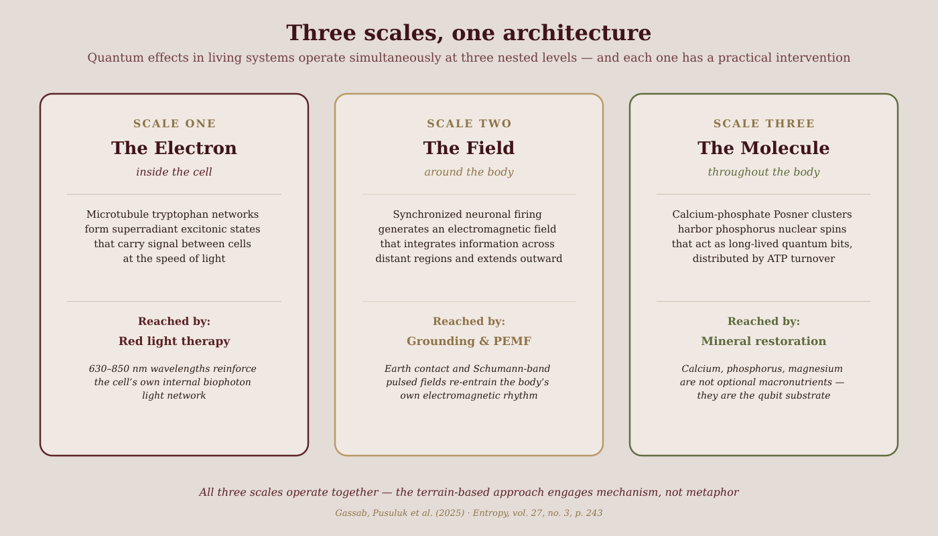
Figure 2: The three scales of quantum biology. Each operates simultaneously, and each is reached by a different terrain-based practice — red light at the electron scale, grounding and PEMF at the field scale, mineral restoration at the molecular scale.
Scale one — the electron
Inside the microtubule, networks of more than a hundred thousand tryptophan transition dipoles form what physicists call superradiant excitonic states. The exciton — the quantum unit of energy — delocalizes along the outer wall of the microtubule, possibly carrying signal between cells. A long-lived counterpart of that state, called subradiant, concentrates on the inner wall, possibly synchronizing the neuron with itself. This is the scale of the cell's internal light network. This is where red light therapy lands.
Scale two — the field
The synchronized firing of millions of neurons generates an endogenous electromagnetic field that surrounds the brain and, by simple physics, extends outside it. The Conscious Electromagnetic Information (CEMI) field theory, developed by Johnjoe McFadden, proposes that this field integrates information across distant regions of the brain and influences neurons back via voltage-gated ion channels near their firing threshold. This is the scale of the biofield as ordinary practitioners experience it — what you sense when an animal is calm, what you sense when one is agitated, what your own body picks up when you walk into a room and know something is off without knowing why. This is where PEMF and grounding land.
Scale three — the molecule
Within calcium-phosphate Posner clusters — formula Ca₉(PO₄)₆ — phosphorus nuclear spins serve as remarkably long-lived quantum bits. ATP hydrolysis distributes these entangled phosphate cages throughout the body. Phosphorus is the ideal biological qubit precisely because its nuclear spin (one-half) resists the kind of electrical decoherence that disrupts larger spins. This is the scale of mineral status — and it is the reason calcium, phosphorus, and magnesium are not optional macronutrients. They are the substrate of molecular-scale quantum coherence. This is where remineralisation lands.
The authors do not insist on a single winner. Their argument is that all three scales likely operate together — and that the practices we use to support health may be reaching each of them at once. Red light reaches the electron scale. PEMF and grounding reach the field scale. Mineral status reaches the molecular scale. The terrain-based approach is not engaging metaphor. It is engaging mechanism — at three scales simultaneously.
What Was Theory Is Becoming Measurement
If all of this sounded like the kind of thing that lived only in theory papers a decade ago, that is because much of it did. What has changed in the last five years is the arrival of measurement tools precise enough to see these processes happening in living cells, in real time.
In 2019, a team led by Luke Lee at Berkeley used gold nanoparticles as plasmonic antennae to image, optically, the actual quantum tunneling of electrons through cytochrome c during cell death — published in Nature Communications. The exponential dependence of tunneling on barrier width that quantum theory had predicted for decades was now observable directly.
In 2021, the Schirhagl group at Groningen functionalized fluorescent nanodiamonds — each carrying a nitrogen-vacancy quantum defect — to target individual mitochondria inside living macrophages. They measured the free-radical magnetic signatures of metabolism directly, with single-organelle resolution, and published in Science Advances. In 2024, the same group extended the method to cardiomyocytes — heart muscle cells — during the exact conditions of cardiac ischemia and reoxygenation, visualizing the redox dynamics of a heart attack at the level of individual mitochondria.
In March of 2026, a team at Washington University in St. Louis took the next step. They coaxed living mouse macrophages to engulf nanodiamond quantum sensors, then used those sensors to measure magnetism and temperature inside the cell simultaneously — from the iron-containing molecules of the mitochondrion itself. Multimodal quantum biosensing inside a living cell is no longer theoretical. It is happening in laboratories now.
What This Means for the Practical Work
The architecture of the terrain-based approach we use at Rooted Saviors — for horses, for dogs, and for the humans who care for them — is not improvisation. Each layer of it sits on a peer-reviewed mechanism. This is what each one is actually doing, mechanistically, when you do it.
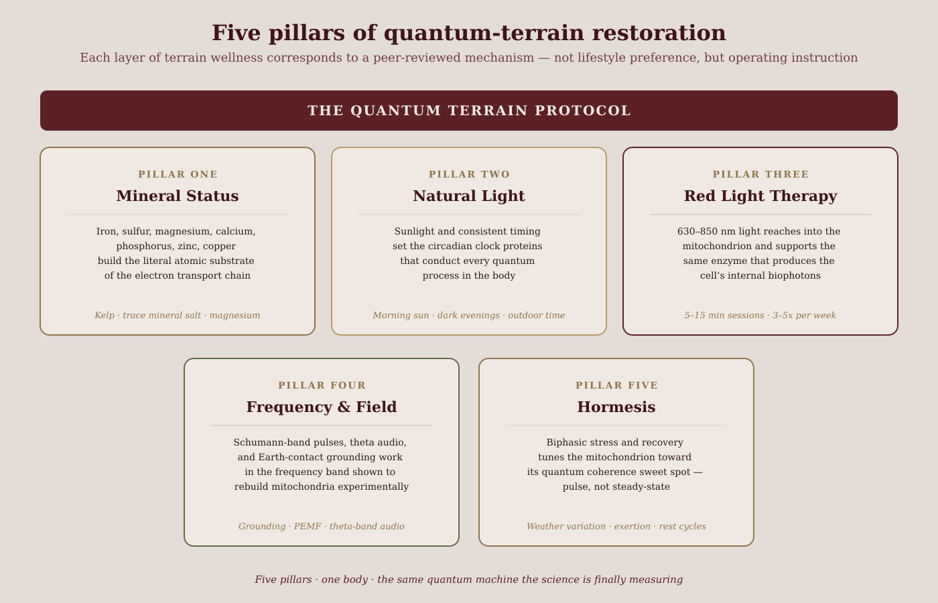
Figure 3: The five pillars of quantum-terrain restoration. Each pillar reaches into a different layer of the quantum architecture of the body — mineral status builds the substrate, sunlight sets the timing, red light reinforces the internal light network, frequency and field work with the substrate directly, and hormesis tunes coherence through biphasic stress and recovery.
Mineral status — the atomic substrate
Iron, sulfur, magnesium, calcium, phosphorus, zinc, copper, manganese, molybdenum. These are not optional. They are the literal atoms from which the electron transport chain, the iron-sulfur clusters, the heme groups, the FAD cofactors, and the Posner phosphate clusters are built. A magnesium-deficient body cannot properly regulate calcium channel activity. An iron-deficient body cannot run Complexes I, II, or III. A phosphorus-deficient body cannot maintain ATP turnover, or — if Fisher and the Posner cluster work are right — the molecular-scale qubits that may synchronize neurons across the body.
• Free-choice trace mineral salt with a full spectrum profile rather than plain sodium chloride alone — for horses, livestock, and where appropriate, for dogs
• Seaweed meal or kelp providing broad-spectrum trace minerals including iodine, zinc, magnesium, and manganese — supports the entire trace mineral economy at once
• Magnesium supplementation where deficiency is suspected — particularly for anxious, hyperreactive, or muscle-tense animals, and equally for humans showing the same patterns
• Regional adjustment for selenium, copper, and zinc based on local soil profile — what is deficient in the ground is deficient in everything that grows on it, and in everything that grazes on it
Sunlight and circadian rhythm — the timing scaffold
A 2022 review in Frontiers in Physiology by Gianluigi Mazzoccoli laid out the chronobiology layer in detail. Every quantum process in biology is clock-gated. The circadian clock proteins — BMAL1, CLOCK, PER, CRY — are not just timekeepers. They are the conductors of the quantum orchestra. Each molecule that participates in coherence has its abundance and its position regulated by the clock. Quantum biology, in other words, is not warm-wet-impossible. It is warm-wet-scheduled.
This is why morning sunlight, evening light reduction, and consistent sleep timing are not lifestyle preferences. They are the conditions under which the quantum machinery is supposed to operate. Disrupt the timing, and the whole orchestra falls out of phase.
• Daily outdoor time in natural light, particularly morning light — for horses, dogs, and humans alike. Even overcast outdoor light provides dramatically more circadian-relevant spectrum than any indoor lighting
• Reduction of blue-spectrum artificial light in the evening hours — for indoor dogs especially, and for the humans they live with
• Sleeping environments dark, quiet, and away from electrical and wireless sources where possible — the body's deepest repair work happens during sleep and is most disrupted when this work is interrupted
• Consistent sleep timing rather than varying schedules — clock proteins respond to consistency more than to total hours
Red light therapy — reinforcing the internal light network
Red and near-infrared light therapy in the 630 to 850 nanometer band reaches into the mitochondrion and supports cytochrome c oxidase — the same enzyme that produces the internal biophotons described earlier. It is, mechanically, an external reinforcement of the same light network the cell is already running on its own. The mechanism is no longer disputed in the photobiomodulation literature.
• Targeted red light sessions of five to fifteen minutes, three to five times per week, for animals in recovery, with chronic inflammation, or under high stress
• Whole-body or large-area panels for senior animals, post-surgical animals, and for human use
• Pair red light sessions with rest rather than activity — the mitochondrial repair work happens during the recovery window after the session
Frequency and field — working with the substrate
The Toda 2022 paper gives mechanistic backing to a category of interventions that has historically been considered fringe. Pulsed electromagnetic field therapy in the low-hertz Schumann band, grounding mats that reconnect with the Earth's natural field, audio frequencies in the theta range — these are working with the same parameter space that, in a peer-reviewed Nature-family journal, was shown to rebuild mitochondria from within.
• Daily grounding contact — bare paws on grass and earth for dogs, genuine pasture on natural ground for horses, bare feet on soil for humans
• PEMF therapy from a quality device for recovery, particularly for animals in heavy training or post-injury, and increasingly used by athletes and chronic-pain patients
• Theta-band audio for stress recovery — for nervous dogs, for stalled horses, and for human use during rest and meditation
• Reduction of artificial RF and ELF exposure in sleeping environments — particularly near animal beds and stall walls, where the body is trying to do its deepest repair work
Hormesis — tuning the coherence sweet spot
A 2016 paper by Nunn, Guy, and Bell at the University of Westminster argued that the mitochondrion lives at a quantum coherence sweet spot — too reduced and it floods the cell with free radicals, too uncoupled and it produces heat without energy. The biphasic stress response — what physiologists call hormesis — is the mechanism by which life tunes itself toward that sweet spot. Inflammation is the chronic loss of that tuning. Aging is what happens when the loss compounds.
This is the mechanistic backing for the old practices: the fast, the cold pool, the sauna, the long walk. They are not arbitrary disciplines. They are quantum tuning. The same principle applies to animals — the horse that spends time in genuine pasture conditions, with temperature variation and varied terrain, tunes itself differently than the horse in climate-controlled confinement. The dog that runs hard and then rests deeply tunes itself differently than the dog in steady moderate activity. Pulse, not steady-state, is the rhythm life is built for.
• Genuine outdoor time with weather and temperature variation rather than climate-controlled confinement — for horses, dogs, and where life allows, for ourselves
• Real exertion followed by real recovery, in animals and in humans — not perpetual moderate activity that never asks for adaptation
• Periodic fasting where physiologically appropriate, with veterinary input for animals with metabolic conditions, and medical input for humans with the same
• Cold and heat exposure in measured doses for humans, where individual tolerance allows
An Honest Perspective — What This Post Is and Is Not Claiming
This topic exists in a space where it is easy either to dismiss the science entirely or to overclaim certainty that the research does not yet support. We want to be clear about where we stand.
We are not claiming that PEMF therapy cures disease, that red light is a substitute for veterinary care, or that mineral supplementation alone will reverse chronic illness. The evidence does not support those specific claims. We are not telling you that any of these practices replace the care of a qualified veterinarian or qualified medical professional. They do not.
What we are saying is this:
• Mitochondria are quantum machines, and their function depends on a specific atomic substrate — iron, sulfur, magnesium, calcium, phosphorus, and the trace minerals that hold these together
• Faint frequencies in the Schumann and theta bands have been shown in peer-reviewed Nature-family research to modulate mitochondrial function through documented mechanisms
• Mitochondria emit biophotons that travel through microtubule waveguides — meaning external light therapy in matching wavelengths reinforces a real, internal light network
• Quantum biology is rhythmically gated by the circadian clock — sleep, light timing, and sunlight exposure are not lifestyle preferences but the operating conditions for the machinery
• Hormesis is the mechanism by which the body tunes itself toward quantum coherence — biphasic stress and recovery is the rhythm life was built for
• These mechanisms apply to animals — horses, dogs — at least as much as they apply to humans, and quite possibly more, given that animals cannot opt out of the environment we place them in
The terrain-based approach does not require the entire field of quantum biology to be settled to be worth doing. It requires only that we take seriously the biological reality that our animals and ourselves are living in bodies designed for specific inputs — mineral, light, frequency, and rhythm — that modern life has systematically reduced. The precautionary, mechanistic, and increasingly well-documented response is to restore what has been lost. That is what the practices in this post are doing.
You cannot reverse the modern environment. You can restore what your body — and your animal's body — was designed to receive. Mineral, light, frequency, rhythm, stillness. The quantum machine has operating instructions. We are finally learning to read them.
To explore the full terrain-based wellness approach for horses, dogs, and the humans who care for them, visit rootedsaviors.com — and follow our continuing work at Stewards Under Pressure on the science and scripture of how living things actually work.
Note: This post is for informational and educational purposes. The terrain-based practices described here are supportive and complementary — not replacements for veterinary or medical care. For health concerns in your animals, always work with a qualified veterinarian. For your own health, consult a qualified medical practitioner. Quantum biology is a rapidly evolving field; some of the mechanisms described above are well-established, while others are active areas of ongoing research. Where the research is still emerging, we have said so plainly.
Sources & Further Reading
1. Bennett J.P. (2019). Medical hypothesis: Neurodegenerative diseases arise from oxidative damage to electron tunneling proteins in mitochondria — Medical Hypotheses — the foundational paper reframing neurodegeneration as damage to the quantum substrate of the electron transport chain.
2. Bennett J.P. & Onyango I.G. (2021). Energy, Entropy and Quantum Tunneling of Protons and Electrons in Brain Mitochondria — Biomedicines — expanded follow-up adding proton tunneling and the energy economics of the brain; relates mitochondrial impairment to aging-related disease.
3. Toda T. et al. (2022). Extremely low-frequency pulses of faint magnetic field induce mitophagy to rejuvenate mitochondria — Communications Biology (Nature family) — the experimental paper showing that 1–8 Hz / 10 microtesla pulsed fields trigger mitochondrial rejuvenation via Complex II.
4. Rahnama M., Tuszynski J.A., Bókkon I., Cifra M., Sardar P., Salari V. (2011). Emission of mitochondrial biophotons and their effect on electrical activity of membrane via microtubules — Journal of Integrative Neuroscience — the foundational paper on mitochondrial biophotons, the microtubule as quantum optical cavity, and the link between cellular coherence and EEG.
5. Nunn A.V.W., Guy G.W., Bell J.D. (2016). The quantum mitochondrion and optimal health — Biochemical Society Transactions — the framing paper on mitochondria as quantum information processors, and hormesis as the mechanism that tunes quantum coherence.
6. Mazzoccoli G. (2022). Chronobiology Meets Quantum Biology: A New Paradigm Overlooking the Horizon? — Frontiers in Physiology — the comprehensive review showing how quantum effects in biology are rhythmically gated by circadian clock proteins.
7. Sound Matrix Shaping of Living Matter: Mitochondria as Energy Portals in Detecting and Processing Sound Vibrations (2024) — International Journal of Molecular Sciences — direct experimental evidence that specific sound frequencies modulate mitochondrial function in cultured human cells through identifiable molecular pathways.
8. Gassab L., Pusuluk O., Cattaneo M., Müstecaplıoğlu Ö.E. (2025). Quantum Models of Consciousness from a Quantum Information Science Perspective — Entropy — the three-scale framework for quantum effects in the brain: microtubule electrons, electromagnetic fields, and phosphate Posner clusters.
9. Xin H., Sim W.J., Namgung B., Choi Y., Li B., Lee L.P. (2019). Quantum biological tunnel junction for electron transfer imaging in live cells — Nature Communications — first real-time optical imaging of quantum biological electron tunneling in living cells, using gold-nanoparticle plasmonic antennae.
10. Norouzi N. et al. (Schirhagl group) (2021). Quantum monitoring of cellular metabolic activities in single mitochondria — Science Advances — nanodiamond quantum sensors targeted to single mitochondria inside living macrophages.
11. Fan S., Schirhagl R. et al. (2024). Quantum Sensing of Free Radical Generation in Mitochondria of Single Heart Muscle Cells during Hypoxia and Reoxygenation — ACS Nano — extension of nanodiamond mitochondrial sensing to cardiac tissue during ischemia and reperfusion.
12. Hamblin M.R. (2017). Mechanisms and applications of the anti-inflammatory effects of photobiomodulation — AIMS Biophysics — red light therapy mechanism and cytochrome c oxidase activation; directly relevant to the mitochondrial biophoton network.
rootedsaviors.org | biofieldapp.com | stewardsunderpressure.org | Terrain Wellness | Quantum Biology | YHWH Covenant


Comments