
In the Beginning Was the Logos: What Modern Mathematics Is Quietly Discovering About the Structure of Reality
- SUP Stewards Under Pressure

- May 24
- 17 min read
Updated: Jun 5
Logos, Information, and the Order of Things
By Stewards Under Pressure: Terrain Wellness | Quantum Biology | YHWH Covenant
Rooted Saviors | Biofield App
Three independent peer-reviewed research programs — in information theory, in experimental quantum physics, and in quantum computation — have converged on a remarkable picture of the prime numbers. The picture is not what the modern mind expects. It is what the patristic tradition has been saying for two thousand years.
The Gospel of John opens with a sentence that the modern reader is taught to handle as poetry. "In the beginning was the Word, and the Word was with God, and the Word was God." The Greek behind that opening sentence is Logos — a word the modern English language has no clean equivalent for. It is the root of logic. It is the root of ratio, of proportion, of measure. It is the root of the verb to speak. In the patristic tradition, it is the word the Greek-speaking Church reached for when it needed to name the ordering principle that underlies all of creation. The Word through whom all things were made.
For most of the modern era, that sentence has been read as a beautiful but vague metaphor. Of course there is order in creation. Of course there is structure. The early Church wrote it down in the way available to them. We, the moderns, would translate that ancient intuition into the language of natural law, of physical constants, of mathematical regularities — and we would consider the matter handled.
In the last two decades, that has quietly stopped being a satisfactory account. The mathematics of the integers — the most basic, most fundamental objects in all of mathematics — and the physics of the quantum vacuum have begun to converge in a way that the textbooks have not yet caught up to. The convergence is not metaphor. It is not analogy. It is published, peer-reviewed work in journals like Quantum, PNAS Nexus, and the IEEE Information Theory Society Newsletter. And what it suggests is that the patristic reading of John 1:1 was not a metaphor at all. It was a technical description of what the universe is, written fifteen hundred years before the technical vocabulary existed to receive it.
This post is a careful, grounded introduction to three peer-reviewed scientific findings about the prime numbers, what they tell us together, and why the convergence matters for the way we think about scripture, creation, and the order of things.
The prime numbers are simultaneously information-theoretic objects, physically realizable quantum objects, and carriers of intrinsic quantum entanglement. These are not three separate facts. They are three views of one underlying structure. And that structure has a name.
The Primes — Why They Matter More Than They Look Like They Should
Before any of the modern findings can land, we need to understand what the prime numbers actually are. A prime number is a positive integer greater than one that cannot be divided evenly except by itself and one. Two, three, five, seven, eleven, thirteen, seventeen — these are the first seven primes. Every integer greater than one is either a prime itself or can be written as a product of primes in exactly one way. This is called the Fundamental Theorem of Arithmetic, and it is the foundation of everything the integers do. The primes are, in this precise sense, the atoms of arithmetic.
What makes them strange is that, despite being so simple to define, their distribution along the number line is profoundly unpredictable. At small scales, the primes appear almost randomly scattered. There is no formula that tells you the next prime given the current one. There is no shortcut. The only way to find primes is to test, one by one, whether each integer is divisible by anything smaller. The eighteen-year-old Carl Friedrich Gauss noticed in 1792 that, while the small-scale pattern is erratic, the large-scale density of the primes follows a smooth law — the Prime Number Theorem — which says the number of primes below a value n is approximately n divided by the natural logarithm of n.
The deepest unsolved problem in modern mathematics — the Riemann Hypothesis, formulated in 1859 — is essentially a refined version of this same question. It asks how precisely the prime counting function can be predicted from the underlying mathematical structure. For one hundred sixty-five years, the world's best mathematicians have tried to prove it, and failed. A million-dollar prize sits unclaimed for the person who finally does.
The primes, in other words, are the place where the universe's mathematical structure is most exposed and most mysterious at the same time. They are the atoms of arithmetic — and they are the holdout, the place where the modern mathematical mind has been forced to admit that there is something here we do not yet understand.
The primes are simple to define and impossible to predict. They are the place where arithmetic stops being computational and starts being structural. They are the atoms of the integers, and the integers are the atoms of mathematics. Whatever the primes are, the universe is partly made of.
The First Finding — Primes Are Information-Theoretic
In 2008, an information theorist named Ioannis Kontoyiannis — then at the Athens University of Economics and Business, later a professor at Cambridge — gave a lecture at the IEEE Information Theory Workshop in Porto, Portugal. The title was Counting the Primes Using Entropy. The result he presented was published in the IEEE Information Theory Society Newsletter that June. It was not new mathematics in the strict sense; the foundational ideas trace back to a 1973 lecture by the probabilist Patrick Billingsley and a 1979 paper by Gregory Chaitin on the mathematical definition of life. But Kontoyiannis cleaned up the argument and showed something quietly remarkable.
Chebyshev's 1852 asymptotic formula — one of the foundational results in the theory of the primes — can be proved using nothing more exotic than Shannon entropy and the uniqueness of prime factorization. Shannon entropy is the central concept of information theory: it measures how much information is contained in a probability distribution. It is what makes data compression possible. It is what makes communication theory work. It is the technical heart of how the digital world handles information.
The argument is short enough to summarize. Pick a random integer between one and some large bound n. The information content of that random integer is, by definition, the logarithm of n. But because of the uniqueness of prime factorization, knowing the integer is the same as knowing its decomposition into primes. So the total information has to equal the sum of the information contained in each prime's exponent. Setting these two quantities equal and bounding both sides — using nothing but elementary inequalities — gives you, in a few lines, a lower bound on the prime counting function. The distribution of the primes falls out of pure information theory.

Figure 1: Three peer-reviewed findings about the primes, published independently in three different journals between 2008 and 2022. Each finding is rigorous on its own. The convergence between them is what this post is about.
Why this matters
This is not a parlor trick. It is a statement that the deepest fact about the integers — how the primes are distributed along the number line — is at root an information-theoretic fact. The arithmetic of the universe and the information theory of the universe are not two separate disciplines that happen to overlap. They are the same discipline viewed from two angles. Whatever the primes are doing, they are doing it according to the rules that govern how information itself behaves.
The Riemann Hypothesis, which has stood unsolved for one hundred sixty-five years, is in this framing a question about how precisely the information-theoretic structure of the integers can be specified. Solving it would not just be a mathematical achievement. It would be a statement about how cleanly information governs reality at the deepest level.
The Second Finding — Primes Are Physically Realizable
If primes are information-theoretic, the next question is whether they are anything else. In December of 2022, a team at the University of St Andrews, working with collaborators at SISSA in Trieste and the University of Trieste, published a paper in PNAS Nexus — an open-access journal in the family of the Proceedings of the National Academy of Sciences of the United States. The paper was titled Holographic realization of the prime number quantum potential. It described an actual experiment, performed in an actual laboratory, that did something the textbooks would not have predicted was possible.
Donatella Cassettari, Giuseppe Mussardo, and Andrea Trombettoni built a small optical apparatus. A 1064-nanometer laser was passed through a spatial light modulator — a device that can shape the phase of light with pixel-level precision — and focused down to a region a few hundred micrometers across. They computed, using the mathematics of supersymmetric quantum mechanics, the exact shape of a potential well whose quantum energy levels would be the first ten prime numbers. Then they computed it for the first fifteen primes. Then they built it. They shaped the laser light into a physical potential whose energy eigenvalues, measured experimentally, were two, three, five, seven, eleven, thirteen, seventeen, nineteen, twenty-three, twenty-nine — and on through forty-seven for the larger version.
The agreement between the experimental measurements and the actual prime numbers was within six to eight percent. The discrepancy came from imperfections in the optical system, not from any failure of the underlying theory. The theoretical method — supersymmetric quantum mechanics applied iteratively to build a potential one energy level at a time — works exactly, in principle, for any finite sequence of integers. The team also built a potential whose energy levels were the lucky numbers, a sequence cousin to the primes. They proposed an apparatus that, in principle, could use quantum mechanical resonance to test whether any given integer is both lucky and prime.
Why this matters
There has long been a quiet assumption that mathematics is the language we use to describe physics — that the physical world is the real thing, and mathematics is the human-built tool for talking about it. The Cassettari experiment quietly inverts that assumption. The primes are not a description we have laid over the world. They are not approximations. They are physical objects. You can build a piece of apparatus whose behavior is exactly described by them. The deepest mathematical objects in the integers have a direct, measurable, physical realization.
This is the experimental side of what Eugene Wigner once called "the unreasonable effectiveness of mathematics in the natural sciences." Wigner wrote that essay in 1960, and he meant it as a puzzle. Sixty years later, the puzzle has acquired a sharper shape. Mathematics is effective in physics because the deepest mathematical objects are physical. The wall between math and physics, which the modern academic structure has carefully maintained for two centuries, is not where the universe puts the wall. The universe does not draw a line between abstract structure and material structure. We did.
You can build a laser apparatus whose energy levels are the prime numbers. The deepest objects in mathematics turn out to be the eigenvalues of a physical system. Mathematics is not a description we have laid over the world. It is what the world is partly made of.
The Third Finding — Primes Carry Quantum Entanglement
Two years before the Cassettari experiment, in December of 2020, a different team — Diego García-Martín, Eduard Ribas, Stefano Carrazza, José Ignacio Latorre, and Germán Sierra — published a paper in the journal Quantum titled The Prime State and Its Quantum Relatives. Latorre and Sierra are established quantum information theorists with multi-decade publication records. The work built on their earlier papers from 2014 and 2015, which had carried titles like Quantum Computation of Prime Number Functions and There Is Entanglement in the Primes. By 2020 they had extended the analysis to thirty qubits — the practical limit of what could be simulated with high-precision arithmetic on contemporary computers.
What is the Prime State? It is a quantum state — the kind of state that quantum computers manipulate — defined as the uniform superposition over all prime numbers less than two to the nth power. If you have ten qubits, you can build a Prime State that is the uniform superposition over all primes less than 1024. If you have twenty qubits, the superposition extends to primes less than a million. If you have thirty, you reach primes less than a billion. The Prime State is constructed using Grover's algorithm, a standard quantum computing technique, with a primality test as its oracle.
What the team found, and what the 2020 paper documents in technical detail, is that the Prime State is not a simple object. It carries quantum entanglement. Entanglement is the property that makes quantum mechanics quantum — it is the phenomenon by which two parts of a quantum system are correlated in ways that cannot be reproduced by any classical mechanism. The Prime State is entangled. And the entanglement entropy of the Prime State scales, the team showed, with the Shannon entropy of the density of square-free integers.
Read that sentence again. The entanglement entropy of a quantum state — a quantum-mechanical quantity — scales with the Shannon entropy of the density of a particular arithmetic class — a purely number-theoretic quantity. The team showed that this relation is intrinsic to the primes, not an artifact of how they happened to encode the state. The same relation appears when the Prime State is built using qudits instead of qubits, and when restricted to primes in arithmetic progressions. The arithmetic structure of the primes IS their entanglement structure.
Why this matters
If Kontoyiannis showed that primes are information-theoretic, and Cassettari showed that primes are physically realizable, then García-Martín, Latorre, and Sierra showed that the primes are quantum mechanically alive. When you express the primes as a quantum state, they exhibit the deepest signature of quantum mechanics — entanglement. And the structure of that entanglement encodes the arithmetic facts. Twin prime density, Chebyshev bias, the distribution of square-free integers — these classical number-theoretic quantities turn out to be measurable as quantum information quantities of the Prime State.
Latorre and Sierra's earlier work showed that, in principle, the Prime State could be used to estimate the prime counting function with precision sufficient to test the Riemann Hypothesis. They have not built that apparatus — yet. But the theoretical machinery is in place. The deepest unsolved problem in mathematics may turn out to be soluble by building a quantum computer in the right state and measuring it.
Three Views, One Structure
Step back. In a span of fourteen years, three independent peer-reviewed research programs — working from completely different angles, in different countries, using different mathematical tools — have converged on a single picture of the prime numbers.
The information-theoretic view: the distribution of primes is a consequence of how information itself is structured. The physical view: the primes can be encoded as the energy levels of a real, physical quantum system, built in a laboratory. The quantum-informational view: expressed as a quantum state, the primes carry entanglement whose structure encodes their arithmetic.
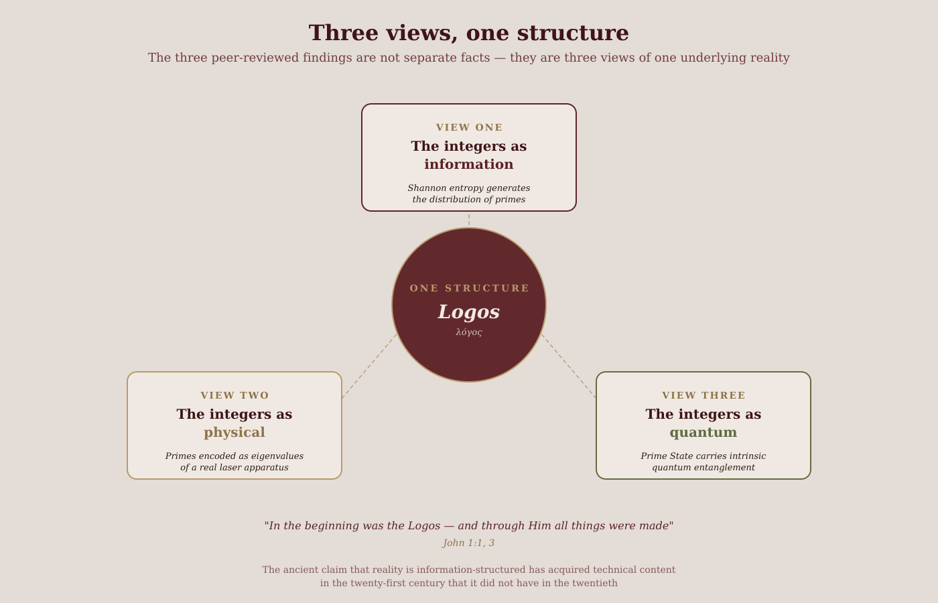
Figure 2: Three independent views — information, physics, and quantum information — converge on one underlying structure. The patristic tradition has a name for this structure. The science is finally meeting the word that has always described it.
These are not three separate findings. They are three views of one underlying structure. The primes — the atoms of arithmetic — are simultaneously information-theoretic, physically realizable, and quantum-entangled. The distinction between mathematics and physics that the modern academic mind takes for granted is not how the universe is built. The universe is built so that the deepest mathematical structure and the deepest physical structure are the same structure.
Whatever the primes are, they are not only mathematical. They are also physical. They are also informational. They are also quantum. The wall between these categories is in our textbooks, not in the universe.
What This Has to Do With the Opening of John
Now we can return to the opening sentence. "In the beginning was the Logos, and the Logos was with God, and the Logos was God. All things were made through Him; and without Him was not anything made that was made."
The Greek word Logos was not chosen casually by the author of the Fourth Gospel. By the time John was writing — late first century, in the Greek-speaking world of the eastern Mediterranean — Logos was a technical philosophical term with a long history. The Stoics used it for the rational ordering principle of the cosmos. Philo of Alexandria, the Jewish philosopher writing a generation before John, used it to bridge Greek philosophical categories with Hebrew theology. By selecting Logos, John was making a deliberate claim: that the ordering principle the Greek philosophers had been groping toward had a name, had a face, had become incarnate in Yeshua of Nazareth.
The patristic tradition — Justin Martyr, Athanasius, the Cappadocian Fathers — read this opening as the most precise theological claim that could be made. The universe is not arbitrary. It is not the product of chance, and it is not the product of competing chaos-gods being subdued. It is structured. The structure has a personal source. The structure is rational, ordered, and intelligible — because the One through whom it was made is rational, ordered, and (in a way the human mind can begin to approach) intelligible.
For most of the modern era, this reading has been treated as poetic. The Enlightenment carved off the technical content of Logos and left only the inspirational shell. The modern reader is taught that John 1:1 is a beautiful expression of religious sentiment. The technical claim — that information, ratio, structure, and intelligence are the ground of reality — was quietly transferred to the philosophy department, where it could be safely contained as a topic of disinterested discussion.
What the last two decades of mathematics and physics have done is recover the technical content of Logos. Not as theology. As technical description. The primes are information-theoretic objects. The primes are physical objects. The primes are quantum-informational objects. The structure of arithmetic is the structure of physics is the structure of information. This is what John 1:1 has always said, written in the language available in the first century. We are only now developing the technical vocabulary in which to receive it.
The Greek Logos is the root of logic, ratio, account, and — through Shannon — information. What the patristic tradition has been saying for two thousand years is that reality is information-structured at its foundation. What twenty-first-century mathematics and physics are quietly discovering is the technical version of that ancient claim.
Why This Matters for the Work
It is tempting, at this point, to treat all of this as a beautiful intellectual curiosity. Look how the science is catching up to the scripture. Look at the convergence. Wonderful. Now let us return to our regular programming.
But the convergence has practical content, and it lands on the work we are doing at Stewards Under Pressure in specific ways.
On the coherence of creation
If the universe is information-structured at its deepest level, then the practices that build coherence in living systems are not arbitrary disciplines. They are working with the grain of reality. Mineral status, sunlight, frequency, rhythm, stillness — the terrain-based practices we describe across all Rooted Saviors content — turn out to be the operating instructions for a quantum machine that is itself structured by the same Logos through whom all things were made. The body is not a separate domain from the cosmos. It is, like the cosmos, a Logos-structured system. The work of healing the terrain and the work of contemplating the structure of reality are not two works. They are one work approached from two ends.
On the divine council and the structure of reality
Michael Heiser's careful work on the divine council framework — recovering the biblical worldview in which YHWH operates through and over a council of created intelligences — gains new traction when the substrate of reality is understood as information. Created intelligences operating within a Logos-structured reality are not violations of the natural order. They are part of it. The Ephesians 6:12 framework — the wrestling with principalities and powers in heavenly places — describes a real engagement with real entities operating within an information-structured cosmos. The disclosure-age confusions about non-human intelligence become considerably easier to navigate when one holds steadily to the principle that there is one ordering Logos, and every other intelligence in the cosmos operates within His ordering, not over it.
On the cultural moment
We live in a cultural moment when many of the people who once spoke confidently about meaning, structure, and order have grown quiet. The materialism of the late twentieth century — the worldview that says reality is made of unconscious matter and consciousness is an accident on its surface — is no longer defensible against the actual findings of physics and information theory. But the institutions have not caught up. There is a window in which serious work can be done by those willing to hold simultaneously to scripture, to peer-reviewed science, and to the honest acknowledgment that what these two are converging toward is something the modern era was not prepared for. That window is part of what Stewards Under Pressure exists to occupy.
An Honest Perspective — What This Post Is and Is Not Claiming
We want to be careful about what is being said here, because the topic invites overclaiming and we want no part of that.
We are not claiming that mathematics proves God exists. The findings discussed above do not constitute a proof of YHWH, of Yeshua, or of any specific theological claim. Mathematical and physical findings do not prove theological propositions in that direction. They cannot, by their nature.
We are not claiming that the peer-reviewed researchers cited — Kontoyiannis, Cassettari, Mussardo, Trombettoni, García-Martín, Latorre, Sierra — endorse any theological reading of their work. They are doing science. The interpretive frame in this post is ours, not theirs. They should not be cited as supporting any religious conclusion.
What we are saying is this:
• The peer-reviewed findings on primes, entropy, and quantum mechanics are real, replicated, and published in established journals
• These findings converge on a picture in which the deepest mathematical objects are simultaneously physical and informational
• This convergence is genuinely difficult to account for from within strict materialism — and easy to account for from within the patristic reading of John 1:1
• The ancient claim that reality is Logos-structured has acquired technical content in the twenty-first century that it did not have in the twentieth
• This does not prove the theological claim, but it does mean the theological claim is no longer in tension with the empirical findings — and in fact predicts them better than the alternatives
• The honest response to this convergence is not triumphalism but careful attention, deep gratitude, and the recovery of a way of seeing that the modern era had set aside
Scripture remains the final authority in matters of faith and life. The findings discussed above are not scripture, and we are not treating them as such. We are saying only that what the findings reveal about the structure of creation is consistent with — and quietly illuminates — what scripture has been saying about the same structure for thousands of years.
Scripture is the final authority. Science is one way of attending carefully to what YHWH has made. When the two are read with care, they do not contradict. They illuminate each other. The convergence we are seeing in our generation is not the end of theology; it is the recovery of a way of reading creation that the modern era had forgotten.
To explore more of the integration between scripture, science, and the structure of creation at Stewards Under Pressure, visit stewardsunderpressure.org. To explore the practical terrain work for horses, dogs, and the humans who care for them at Rooted Saviors, visit rootedsaviors.com.
Note: This post is for theological, philosophical, and educational reflection. The scientific findings discussed are summarized faithfully from peer-reviewed sources; the theological framing is the author's own and is offered for prayerful consideration, not as authoritative interpretation. For questions of biblical exegesis, consult faithful pastors, teachers, and the rich tradition of the Church. For questions about the underlying mathematics and physics, consult the original peer-reviewed sources listed below.
Sources & Further Reading
1. Kontoyiannis, I. (2008). Counting the Primes Using Entropy — IEEE Information Theory Society Newsletter, June 2008 — the elementary information-theoretic proof of Chebyshev's 1852 asymptotic formula for the distribution of primes, using only Shannon entropy and the uniqueness of prime factorization.
2. Cassettari, D., Mussardo, G., & Trombettoni, A. (2022). Holographic realization of the prime number quantum potential — PNAS Nexus, 2(1), pgac279 — experimental construction of a quantum potential whose first N energy eigenvalues are the first N prime numbers, using computer-generated holography and spatial light modulators. Demonstrated for N=10 and N=15.
3. García-Martín, D., Ribas, E., Carrazza, S., Latorre, J.I., & Sierra, G. (2020). The Prime state and its quantum relatives — Quantum, 4, 371 — construction and analysis of the Prime state — a quantum superposition of all primes below 2ⁿ — showing intrinsic quantum entanglement whose entropy scales with the Shannon entropy of the density of square-free integers. Studied up to 30 qubits.
4. Latorre, J.I., & Sierra, G. (2014). Quantum Computation of Prime Number Functions — Quantum Information & Computation 14:577 — the foundational paper showing that the Prime state can be constructed via Grover's algorithm with a Miller-Rabin oracle, and that its entanglement encodes number-theoretic functions including twin prime density and Chebyshev bias.
5. Latorre, J.I., & Sierra, G. (2015). There is entanglement in the primes — Quantum Information & Computation 15:622 — expanded analysis showing that the Prime state carries genuine quantum entanglement and that this entanglement scales with the arithmetic structure of the primes.
6. Mussardo, G. (1997). The quantum mechanical potential for the prime numbers — preprint (semiclassical analysis) — the original theoretical work proposing that a quantum potential could be constructed whose energy eigenvalues are the primes. The Cassettari et al. (2022) paper experimentally realized this proposal.
7. Schumayer, D., & Hutchinson, D.A.W. (2011). Colloquium: Physics of the Riemann Hypothesis — Reviews of Modern Physics, 83, 307 — comprehensive review of the physical and quantum-mechanical approaches to the Riemann Hypothesis, including the Berry-Keating conjecture that the zeros of the Riemann zeta function correspond to the energy levels of some quantum system.
8. Wigner, E.P. (1960). The Unreasonable Effectiveness of Mathematics in the Natural Sciences — Communications on Pure and Applied Mathematics, 13(1) — the foundational essay framing the puzzle of why mathematics describes physics so well. The findings in this post are a partial answer: mathematics describes physics because the deepest mathematical objects are physical.
rootedsaviors.org | biofieldapp.com | stewardsunderpressure.org | Terrain Wellness | Quantum Biology | YHWH Covenant


Comments